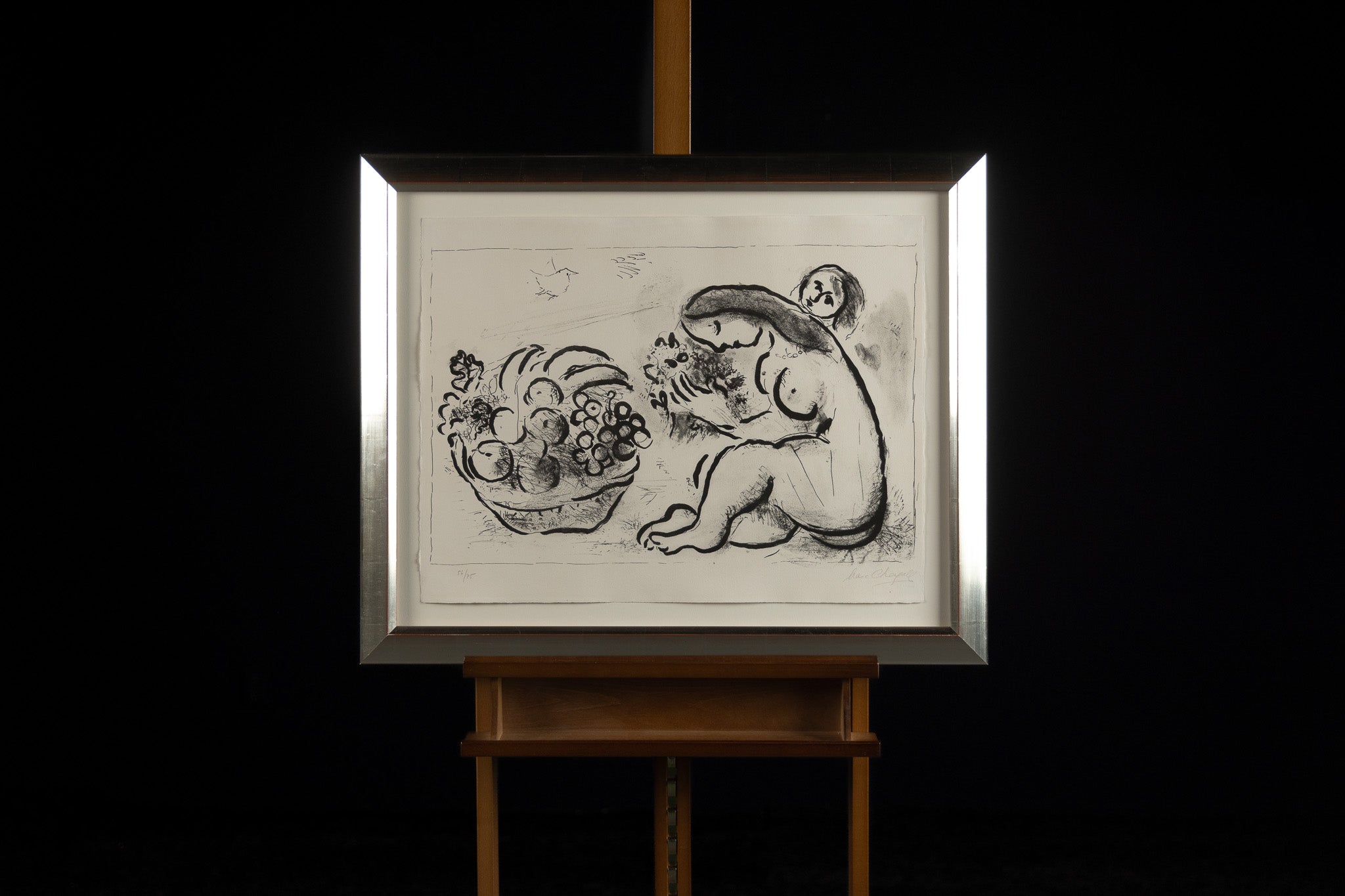
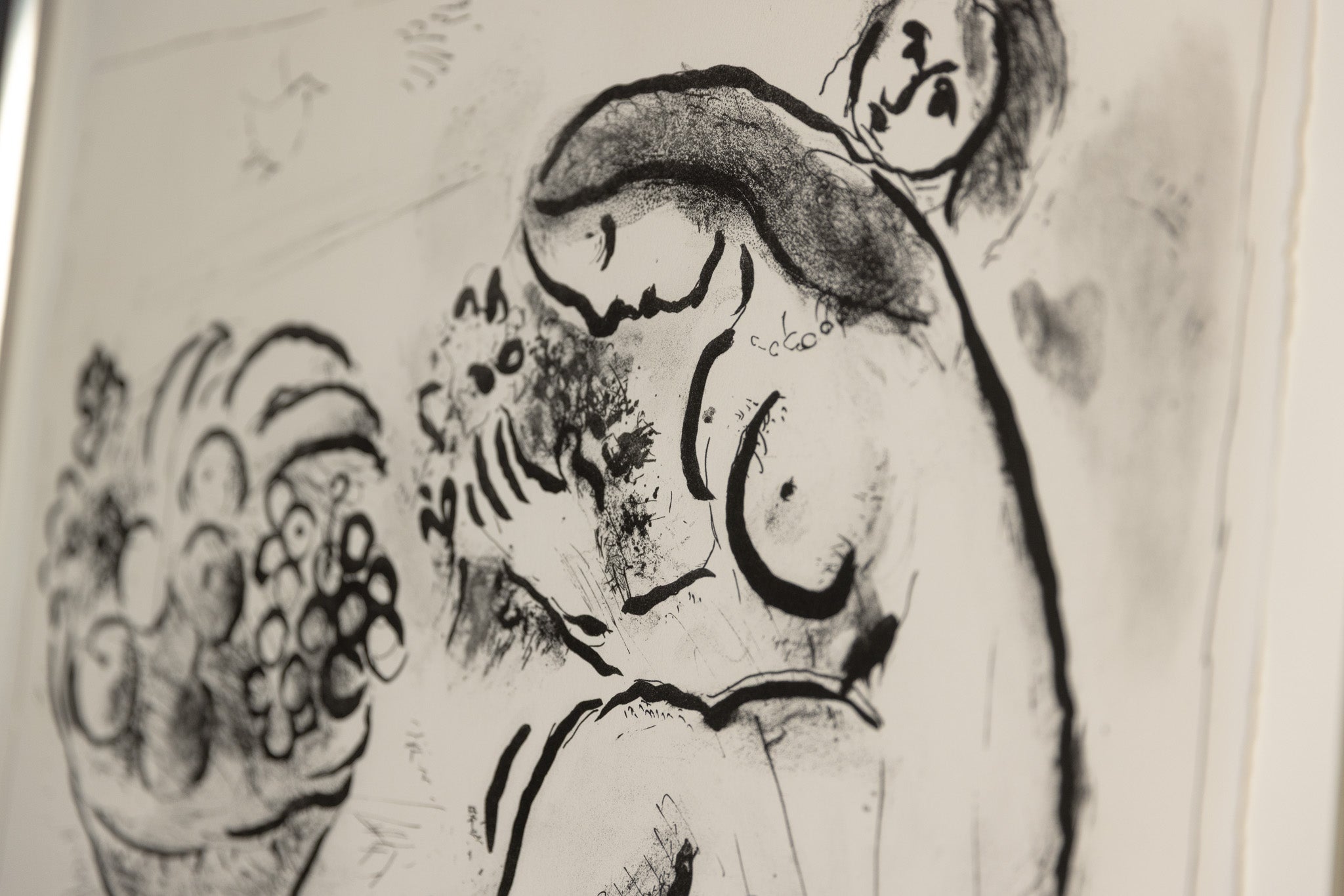
Marc Chagall (1887–1985) was a Belarusian-born Jewish artist whose poetic synthesis of memory, folklore, modernism, and sacred imagery reshaped 20th-century painting. Trained in Vitebsk and St. Petersburg before moving to Paris in 1910, he absorbed Fauvism and Cubism while developing a deeply personal visual language. His work spans painting, printmaking, theatre design, murals, and stained glass, and is held in major public, private, and corporate collections worldwide.Marc Chagall (1887–1985) was a Belarusian-born Jewish artist whose poetic and deeply personal visual language made him one of the most distinctive figures of 20th-century modernism. Born Moishe Segal in Liozna, near Vitebsk, into a Jewish family, Chagall was the eldest of nine children. His upbringing in the religious and cultural life of Vitebsk would remain central to his imagination, returning throughout his career in images of village life, lovers, musicians, animals, floating figures, and sacred symbolism.
From 1906 to 1909, Chagall studied in Vitebsk and then in St. Petersburg, where he trained under influential figures including Léon Bakst, the Russian painter and stage designer associated with the avant-garde group Mir Iskusstva, or The World of Art. This period was marked by difficulty, as Jewish residents faced severe restrictions in St. Petersburg and could remain there only with official permission. During visits back to Vitebsk, Chagall met Bella Rosenfeld, who would become his wife and one of the most enduring presences in his life and art.
In 1910, Chagall moved to Paris, where he encountered the energy of the European avant-garde. He absorbed the formal innovations of Fauvism and Cubism while resisting strict alignment with any single movement. In Paris, he associated with leading cultural figures including Guillaume Apollinaire, Robert Delaunay, and Fernand Léger, and exhibited at the Salon des Indépendants and the Salon d’Automne in 1912. Through Delaunay, Chagall was introduced to the Berlin dealer Herwarth Walden, who organized a solo exhibition of his work at Der Sturm gallery in 1914.
Chagall returned to Vitebsk shortly before the outbreak of the First World War. In 1916, his daughter Ida was born, and following the Russian Revolution, he became involved in the artistic and political life of the region. He was appointed Commissar of Arts for Vitebsk and founded the Vitebsk People’s Art School, an ambitious institution that attracted major avant-garde artists, including Kazimir Malevich. Chagall’s temperament, however, was better suited to artistic vision than political administration, and tensions with other artists eventually led him to leave Vitebsk. He later worked in Moscow, where he created designs and decorations for the State Jewish Chamber Theatre.
In 1923, Chagall left Russia, travelling first to Berlin before settling once again in Paris. There, he reconnected with the artistic circles he had known before the war and developed an important relationship with the publisher and art dealer Ambroise Vollard, who commissioned him to illustrate a number of literary works. During this period, Chagall also published his memoir, originally written in Russian and later translated into French by Bella. He continued to write poetry and essays, many of which were published in journals and collected after his death.
The interwar years brought increasing recognition. A major retrospective was held at Galerie Barbazanges-Hodebert in Paris in 1924, and Chagall travelled widely throughout Europe and to Palestine. In 1933, the Kunsthalle Basel organized a major retrospective of his work. As Nazism rose in Europe, however, Chagall’s position became increasingly precarious. His works were confiscated in Germany, and several appeared in the notorious auctions of so-called “degenerate art.” With the threat to Jewish life intensifying, Chagall and his family eventually sought refuge in the United States.
In 1944, Bella died, a devastating loss for Chagall both personally and artistically. She had been his companion, muse, and recurring subject, and her presence continued to haunt his work long after her death. Chagall returned to France in 1947 and later settled in Saint-Paul-de-Vence. In 1952, he married Valentina Brodsky, known as Vava, and entered a late period marked by major public commissions and international acclaim.
Across a long and prolific career, Chagall worked in painting, drawing, printmaking, book illustration, theatre design, ceramics, tapestry, murals, and stained glass. His large-scale public projects include stained-glass windows for the Hadassah Medical Centre near Jerusalem, the cathedral of Metz, and the Fraumünster in Zurich; the ceiling of the Paris Opéra; and monumental murals for the Metropolitan Opera House in New York. These works extended his symbolic and dreamlike imagery into architectural space, affirming his rare ability to unite modernism, memory, and sacred imagination.
Marc Chagall died in Saint-Paul-de-Vence on March 28, 1985, at the age of 97. His work remains central to the history of modern art, distinguished by its lyrical colour, spiritual depth, and unmistakable fusion of personal memory, Jewish heritage, folklore, biblical imagery, and avant-garde experimentation.